Challan
Why CCTVs Need Human Verification Before Issuing E-Challans

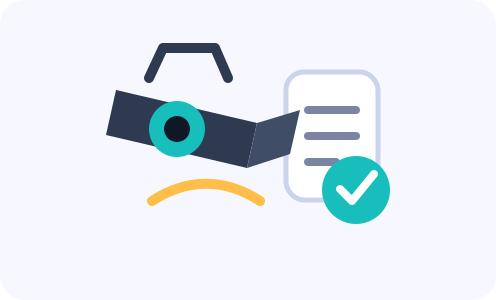
A camera catches a violation. You expect a fine to arrive at once. It rarely works that way.
Between the camera and your phone sits a quiet checkpoint. It is the human verification e challan step. A person reviews the case before any fine goes out.
This guide explains that challan review process. We show why it exists and why some challans are never issue at all. Our guide to traffic fines in India [internal link to: L1 Pillar: E-Challan and Traffic Law] covers the basics.
How an E-Challan Begins
It starts with a camera. CCTV, ANPR, and speed cameras watch the road around the clock. They capture a photo and a short video of each violation.
Different cameras catch different faults. Red light cameras flag signal jumps. Speed cameras flag overspeeding. Other units spot no helmet or wrong way driving.
A local processing unit then reads the scene. It picks out the number plate and the type of offence. This raw flag is only the first step.
The volume is the real problem. A single city can throw up lakhs of flags a day. No team can issue all of them blindly, and they should not try.
This is why the system needs a filter. The flags must be sorted before any fine goes out. The machine sorts at speed, but it cannot be the last word.
The Human Verification Echallan Step
Before any fine, an operator opens the captured image and video. They check the plate and match the vehicle details. Only clean, correct cases move ahead.
An officer then approves the case. Only after that does the system send an SMS with a payment link. This whole stage is the manual review that protects you.
Chandigarh explains its flow openly. Cameras capture, a unit processes, operators check, and an officer approves. The challan reaches the central portal only after that human verification echallan check.
This officer approval is not just a habit. A challan is a legal demand for money. It should carry the sign off of an authorised officer, not a raw machine guess.
Why Machines Alone Get It Wrong
AI is fast, but it is not perfect. Bengaluru ran its system for a year with about 97 percent accuracy and no human check.
That gap caused real harm. Errors came from misread plates, blurry frames, and mistaken identity. Cloned plates were the worst, where one car wears another car's number.
Indian roads make this harder than most. Plates come in many fonts, sizes, and states of repair. Mud, glare, and dim light all confuse a camera.
Bad plates are common too. A bent, dirty, or fancy plate is easy to misread. One wrong digit can send a fine to a total stranger.
A 97 percent rate sounds high. At city scale it still means thousands of wrong fines. That is why a human step is not optional.
Cloned plates are the hardest case. A criminal copies a real number and fixes it to another car. The honest owner then gets fines for trips they never made.
Stylised and fancy plates add to the mess. A camera can misread an artistic font or a bent plate. Some cities now build a database of fake plates to catch these tricks.
How the Challan Review Process Works
The challan review process runs in clear stages. Each stage filters out a few more errors.
| Stage | What happens |
|---|---|
| Capture | Camera records the violation photo and video |
| Processing | A unit reads the plate and the offence |
| Operator check | A person matches the plate and vehicle |
| Officer approval | An officer confirms the case is correct |
| Dispatch | An SMS with a payment link is sent |
The challan review process is the safety net. It removes false positives before they cost you money.
Each stage has a clear owner. The processing unit handles the reading. The operator handles the match. The officer holds the final call. This split keeps the work accountable at every step.
The Cost of Skipping the Review
Skip the human step and the errors flood in. Bengaluru learnt this the hard way. A year of pure automation left a trail of wrong fines.
People then waste days fixing those mistakes. They queue at offices and write emails to clear a fine they never earned. The whole system slows under the weight of disputes.
A strong challan review process stops that spiral. It catches the error before it ever leaves the building. One careful check saves a hundred angry complaints later.
Why Some Challans Never Issue
Not every camera flag becomes a fine. If the plate does not match the image, the case is dropped. If the photo is too poor to read, it is dropped too.
Cloned plate cases get flagged and held back. The system will not punish the wrong owner if the check catches the mismatch. So many flags quietly die at this stage.
What Human Checks Fixed
Bengaluru shows the payoff. It moved to manual checking of every violation image. Accuracy then rose to about 99.9 percent.
The wrong images are not wasted. They are fed back to train the model. Over time the machine learns and makes fewer mistakes.
This blend is the goal. The machine does the heavy sorting at speed. The human catches the errors the machine cannot see. Together they beat either one alone.
What a Valid E-Challan Should Show
A fair challan carries clear proof. It should show the photo or video of the act. It should name the offence, the place, and the time.
It should match your vehicle exactly. The plate, the make, and the colour must line up. A mismatch on any of these is a strong ground to dispute.
The amount should fit the offence and the law. An odd figure is worth a second look. A proper challan review process keeps these details honest before dispatch.
Why the Fine Can Take Days
The human step adds time, and so does the rest of the chain. The flag waits in a queue at the command centre. An operator reaches it only in turn.
The system must also find the owner. It looks up the address linked to the plate in the vehicle database. Challans then go out in bulk batches, not one by one.
So a gap of a few days is normal. The delay is the price of getting the fine right. A rushed system would punish far more wrong people.
Patience here protects you. A challan that arrives later has passed more checks. The wait is a sign the system is doing its job, not failing it.
Why the Human Step Builds Trust
A wrong fine does more than annoy. It makes people doubt the whole system. Trust is hard to win back once it slips.
Every wrong challan also clogs the appeals desk. Staff spend hours fixing errors that a check could have stopped. The human step saves that effort up front.
So the check protects more than your wallet. It protects faith in fair enforcement. People pay honest fines more readily when they trust the process.
How to Dispute a Wrong E-Challan
Start with the image, not the payment. Open the challan and study the photo. Check the plate, the make, and the colour of the vehicle.
Gather your proof if it is not your car. A clear photo of your own plate helps. So does any record that places your vehicle elsewhere at that time.
Then raise the dispute through the right channel. Most states allow an objection on the challan portal. Some cities take complaints by email or at a traffic centre.
Stay alert for fake challan scams too. Never pay through a random link or a personal UPI number. Use only the official portal to check and pay.
Scammers copy the look of real notices. They send a link and a tight deadline to rush you. A real challan is always traceable on the official portal, so verify there first.
Why States Differ in Their Checks
Not every city runs the same system. Some have full manual review of each image. Others lean more on the machine and check only flagged cases.
The trend is clear, though. After public anger over wrong fines, more cities added human checks. The human verification echallan step is becoming the norm, not the exception.
This is why your experience can vary by place. A challan in one city may carry a tighter review than in another. The safe move is the same everywhere, which is to verify before you pay.
How to Read Your Challan Image
The photo is your first clue. Zoom in on the number plate. Check every digit and letter against your own plate.
Then look at the vehicle itself. Note the make, model, and colour. A scooter challan on your car plate is a clear sign of a cloned plate.
Check the place and time next. Were you even in that area then. A simple location mismatch can be strong proof in your favour.
Save everything before you act. Download the image and note the challan number. A solid record makes your dispute quick and clean.
What This Means for You
You can still receive a wrong challan. So always open the image first. You can check the challan online with your vehicle number and study the photo.
If the vehicle or plate is not yours, dispute it with proof. To see the full journey, read the CCTV to notice pipeline [internal link to: Sibling: How E-Challans Are Generated, The CCTV-to-Notice Pipeline] and how ANPR cameras read plates [internal link to: Sibling: How ANPR Cameras Read Indian Number Plates].
It also explains why e-challans take days to appear [internal link to: Sibling: Why E-Challans Take Days to Show Up]. More such guides sit in our how e-challans work explainers [internal link to: L2 Anchor: E-Challan Mechanics sub-cluster hub].
A Common Myth, Cleared Up
Many people think a camera fine is automatic. They believe the machine alone decides. That is not how a fair system works.
A camera only raises a flag. A person must confirm it before it becomes a fine. That manual step stands between the flag and your phone.
So a wrong fine is not proof the system is broken. It is a sign a check was missed. The fix is more human review, not less.
Conclusion
A camera only starts the story. The human verification echallan step decides if a fine is fair. The challan review process filters errors so the wrong owner is not punished. It slows things down, but it keeps the system honest. That trade is worth it. So check every challan, study the image, and pay only what is truly yours.
Frequently Asked Questions
What is the human verification echallan step?
The human verification echallan step is a manual check before a fine. An operator matches the plate and an officer approves. Only then is the challan sent.
Why does the challan review process exist?
The challan review process exists to catch errors. Cameras misread plates and confuse cloned numbers. A human check stops the wrong owner from being fined.
Can a wrong e-challan be issued?
Yes, it can still happen. No system is perfect even after the human verification echallan check. If the image is not your vehicle, you can dispute it.
Why do some challans never reach me?
Some flags fail the review. A poor image or a plate mismatch gets the case dropped. So not every camera capture becomes a fine.
Does a human approve every e-challan?
In a proper challan review process, yes. An officer approves each case before dispatch. Cities like Bengaluru now check every image by hand.




CarInfo is your all-in-one app for all your vehicle info needs and RTO vehicle information. Now manage all your vehicles in one place. Trace your car number with owner name


Velocitypedia Private Limited, Unit 231, D21 Corporate Park, New Delhi : 110077
Follow Our Journey:
.e182ab86.svg)


Popular Hatchbacks
Download the
CarInfo App: