Insurance
Third Party Bike Insurance in India: What It Covers and Current Premium Rates

For
a 110cc scooter, the law asks for about Rs 714 a year. That is
roughly two rupees a day, less than a cup of chai, and it is the
cheapest legal thing a two-wheeler owner can buy.
The question worth asking is what those two rupees actually buy. A great many riders assume the answer is basic protection for themselves and their bike. It is not. Third-party insurance is built for somebody else entirely, and understanding that one fact changes how you think about whether it is enough for you. Sometimes it genuinely is. This guide sets out what the cover does, what the current rates are, and how to work out honestly which side of that line your bike sits on.
What a Third Party Bike Insurance Covers
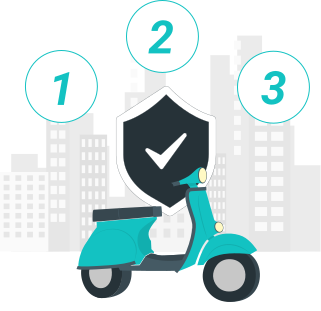
The name is literal. In an accident, there are three parties: you (the first), your insurer (the second), and the person you have harmed (the third). A third party policy pays that third person. The beneficiary is never you.
What it pays for:
Injury, disability, or death caused to another person. There is no upper limit on this. Compensation is decided by the Motor Accident Claims Tribunal, based on factors like the victim's age and earnings, and your insurer pays the amount awarded.
Damage to somebody else's property, which includes their vehicle, a wall, a shopfront, or a gate. This is capped at Rs 1 lakh for a two-wheeler.
Legal costs arising from third party claims made against you.
A compulsory personal accident cover of Rs 15 lakh for you as the owner-rider, paying out on accidental death or permanent disability. This is the one part of a third party policy that protects you, and it is mandatory on every two-wheeler policy sold.
What it does not pay for:
Any damage to your own bike, from any cause. Accident, fire, flood, riot: none of it is covered.
Theft of your bike. If it is stolen, you receive nothing.
Repairs after a fall, even one that was not your fault, unless you pursue the other rider yourself.
Any add-ons. Zero depreciation, engine protection and the rest are only sold with own damage cover.
A No Claim Bonus. Claim-free years on a third party-only policy earn you no discount, because NCB applies solely to the own damage premium.
That Rs 1 lakh property cap deserves a hard look, because riders underestimate it. Clip the door of an expensive car, and a repair bill can run well past a lakh. Your insurer pays the first lakh; the rest is your personal liability, and it does not matter that you were insured. On the injury side, by contrast, the cover is unlimited, which is precisely why the law insists on it. A serious injury award can run into many lakhs, and that is the catastrophe this policy exists to prevent.
IRDAI Third Party Premium Table for Two-Wheelers
Third-party premiums are notified by the IRDAI and are identical at every insurer in India. There is no bargaining, no comparison shopping, and no discount to hunt for. The rate depends only on your engine's cubic capacity.
|
Engine capacity |
Annual third party premium |
|---|---|
|
Not exceeding 75cc |
Rs 538 |
|
Exceeding 75cc but not exceeding 150cc |
Rs 714 |
|
Exceeding 150cc but not exceeding 350cc |
Rs 1,366 |
|
Exceeding 350cc |
Rs 2,804 |
A few things the table does not show:
GST is extra. Add 18% to the figures above to get what you actually pay.
Electric two-wheelers are rated differently, on battery power in kilowatts rather than cc, and they get a regulator-approved discount. The smallest category, up to 3kW, works out to roughly Rs 457 a year.
New bikes pay upfront for five years. A brand-new two-wheeler must be sold with a five-year third party policy, with the longer premium collected at the time of purchase rather than annually.
The Rs 15 lakh personal accident cover is charged separately, as a small additional amount on top of the third party premium.
One honest caveat on the figures. These rates have stood unchanged for several years and a revision has been under discussion for some time. The premium that applies to you is always the one in force on the day your policy begins, so confirm the current rate at renewal rather than assuming last year's number still holds.
How to Check If Your Bike Is Third Party or Comprehensive
Many riders genuinely do not know which they hold, particularly if the policy came bundled with the bike. There is one reliable test and two useful shortcuts.
The reliable test: look for the IDV. Open your policy schedule. If it shows an Insured Declared Value for the bike and a separate Own Damage premium line, your cover is comprehensive. If there is no IDV and the only premium shown is the third party amount plus the personal accident charge, you hold third party cover alone. The document title is a second clue: comprehensive policies are usually called Package Policy, while third party ones are labelled Liability Only or Act Only.
Shortcut one: your insurer's app. Log in and the policy summary names the cover type, with the full schedule available to download.
Shortcut two: your registration number. If you have no document and cannot recall who insures you, an app such as CarInfo will check the RC details for your number plate returns the insurer's name and the date your cover expires. Be clear about its limits, though: this tells you who insures the bike and until when, not whether the cover is third party or comprehensive. Use it to find your insurer, then settle the type question on the document itself.
How to Download Your Third Party Bike Certificate
The certificate is the proof you must produce at a check, and getting a copy takes minutes.
Your insurer's app or website. Log in with your registered mobile number, or use the self-service option with your vehicle number and an OTP, then download the PDF.
Your email. The certificate was emailed when the policy was issued. Search for the insurer's name, your registration number, or the words policy certificate, and check spam and promotions.
DigiLocker. Fetch the policy into the government's document wallet by selecting your insurer and entering your details.
Customer care. A call gets a duplicate emailed after a short identity check, which is the route to take if your registered mobile number has changed.
There is a good reason to do the DigiLocker step even if you already have the PDF. A policy shown through DigiLocker or mParivahan is legally accepted by the traffic police, while a screenshot or a photograph in your gallery is not treated the same way. If you bought a new bike, remember your third party certificate may run for five years, so the expiry date on it will not match your annual own damage policy if you have one.
Third Party Only vs Comprehensive: When TP Is Enough
Most articles will tell you that comprehensive is always better. That is not quite honest. Comprehensive cover is better protection, certainly, but there comes a point where you are paying real money to insure something that is worth very little, and third party alone becomes the sensible choice.
The maths is simple. Comprehensive cover pays out, at most, your bike's Insured Declared Value. As the bike ages, that IDV falls steeply. Once it has fallen far enough, the own damage premium plus any add-ons starts to look large next to the largest cheque you could ever receive.
|
Your situation |
Sensible choice |
Why |
|---|---|---|
|
New bike, bought on finance |
Comprehensive |
The bike is worth a lot, and a lender usually expects it to be protected |
|
Bike under 5 years old, healthy IDV |
Comprehensive, with zero depreciation |
Theft or a bad fall would cost you a meaningful sum |
|
Bike parked on the street in a theft-prone area |
Comprehensive |
Third-party pays nothing at all if the bike is stolen |
|
The bike is 8 to 10 years old, IDV down to a few thousand rupees |
Third-party is defensible |
The most you could claim is small, so the own damage premium buys little |
|
Second bike, rarely ridden, low value |
Third-party is usually enough |
Low exposure and low value make own damage cover poor value |
|
You could not replace the bike with savings tomorrow |
Comprehensive |
This is the real test, whatever the age of the bike |
A
useful way to decide: compare the annual comprehensive premium
against the bike's IDV. If you are paying a large slice of the bike's
entire insured value every single year just for own damage cover, and
a total loss would hand you a cheque you would barely notice, third
party is the rational call.
But apply the last row of that table honestly, because it overrides the rest. If losing the bike would genuinely hurt, keep the own damage cover regardless of what the arithmetic says. And whichever way you go, third party cover remains compulsory, so you are never choosing between insurance and none. When you renew, comparing bike insurance options with your correct IDV in hand shows you exactly what the own damage portion is costing, which is the number this decision turns on.
FAQs
1. What does third party bike insurance actually cover?
It covers injury, disability, or death caused to another person, with no upper limit, and damage to someone else's property up to Rs 1 lakh. It also includes the compulsory Rs 15 lakh personal accident cover for the owner-rider. It pays nothing towards your own bike.
2. Does third party insurance cover damage to my own bike?
No. Not from an accident, not from fire, flood, or riot, and not from theft. Any repair or replacement of your own two-wheeler is entirely out of pocket unless you hold own damage or comprehensive cover.
3. How much is third party bike insurance in India?
It is fixed by IRDAI according to engine capacity: Rs 538 up to 75cc, Rs 714 for 75 to 150cc, Rs 1,366 for 150 to 350cc, and Rs 2,804 above 350cc, before 18% GST. Every insurer charges the same amount.
4. Why is the premium the same at every insurer?
Because the IRDAI notifies third party rates centrally. Insurers have no freedom to raise or lower them, which is why comparison shopping only helps on the own damage portion of a comprehensive policy.
5. What is the maximum third party payout for property damage?
Rs 1 lakh for a two-wheeler, which is far lower than the Rs 7.5 lakh limit for cars. Damage beyond that becomes your personal liability. Compensation for injury or death, however, has no ceiling.
6. How do I know if my bike has third party or comprehensive cover?
Check your policy schedule for an IDV. If an Insured Declared Value and a separate Own Damage premium appear, the cover is comprehensive. If neither is present, it is third party only. The title, Liability Only versus Package Policy, confirms it.
7. Do I earn a No Claim Bonus on a third party policy?
No. NCB discounts only the own damage premium, so claim-free years on a third party-only policy earn you nothing. If you later move to comprehensive cover, you start building the bonus from that point.
8. Is third party insurance enough for an old bike?
It can be. Once the IDV has fallen to a few thousand rupees, own damage cover buys you very little, and third party alone is a defensible choice. The exception is if losing the bike would genuinely hurt your finances, in which case, keep the fuller cover.
9. Do new bikes need a five-year third party policy?
Yes. A new two-wheeler must be sold with a five-year third party policy, with the premium collected upfront. You can still insure the bike itself on an annual basis through a standalone own damage policy.
10. Is a digital third party certificate valid at a traffic check?
Yes, when shown through DigiLocker or mParivahan. A plain screenshot or photograph does not carry the same standing, so pull the certificate into one of the official apps.



CarInfo is your all-in-one app for all your vehicle info needs and RTO vehicle information. Now manage all your vehicles in one place. Trace your car number with owner name


Velocitypedia Private Limited, Unit 231, D21 Corporate Park, New Delhi : 110077
Follow Our Journey:
.e182ab86.svg)


Popular Hatchbacks
Download the
CarInfo App: